When a club launches a new shirt, it usually does it at home: a photoshoot at the stadium, a film on the feed. This week Paris Saint-Germain and Jordan Brand did something different with their new third kit. They took it to Abidjan, Dakar and Casablanca first.
What happened
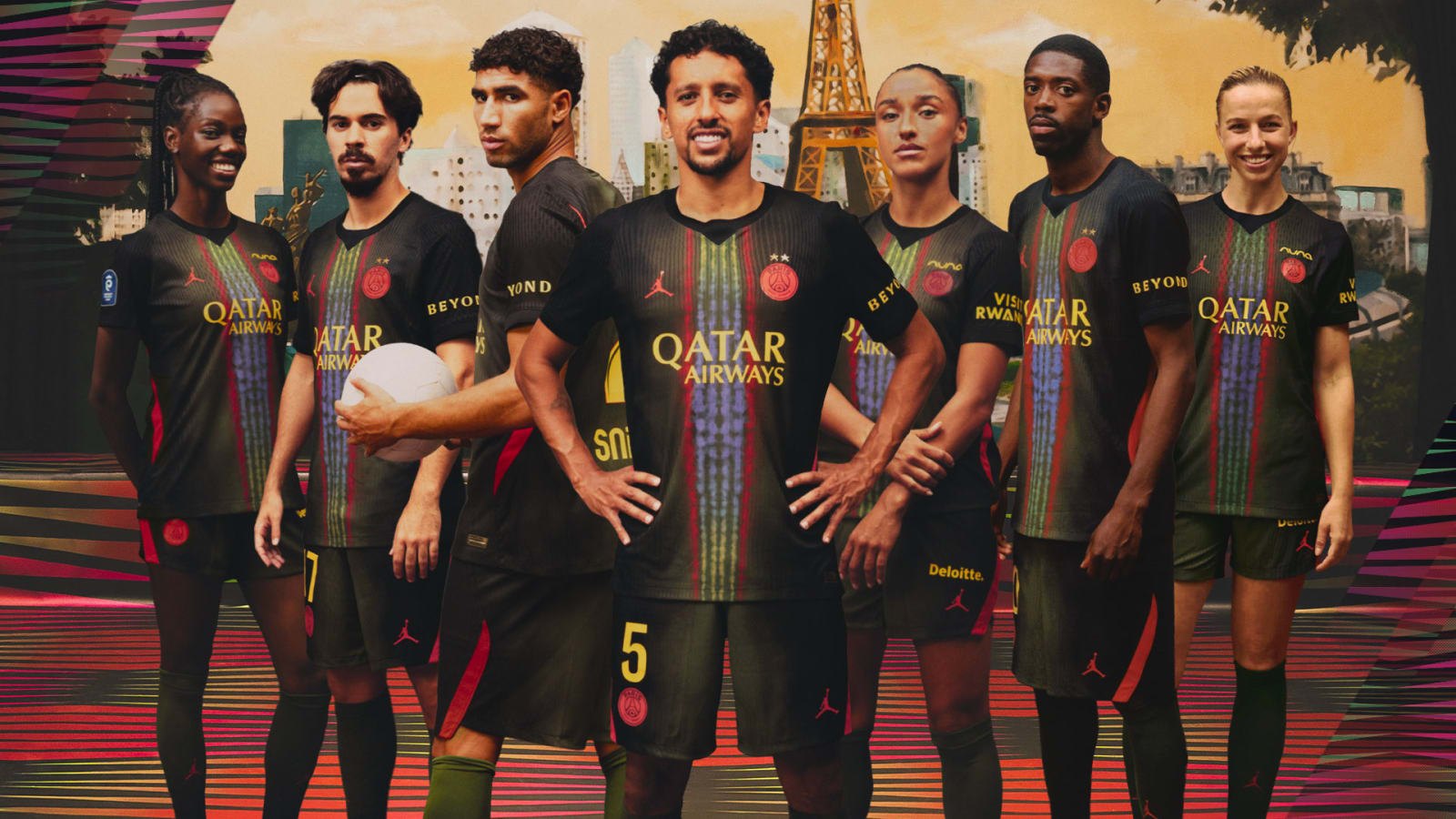
PSG and Jordan Brand unveiled the 2026/27 third kit on 23 November: a dark shirt with a tie-dye effect in shades of green, and fine stripes of green, red and purple down the middle where PSG's famous central stripe usually sits. A lifestyle collection came with it, with 1990s-style jackets, hoodies and tracksuits.
The launch was built around a journey. Four creators, Djibril94260, Zepeck, Daddy Chulo and Aché Issakha, travelled to Abidjan in Ivory Coast, Dakar in Senegal and Casablanca in Morocco. They met the Abidjan Supporters Club, young players at the PSG Academy in Saly, and three former PSG players: Amara Diané, Bonaventure Kalou and Oumar Dieng. They shared it all on their own channels as well as PSG's and Jordan's.
The journey ended in Paris on 25 November with a pop-up in Barbès, in the 18th arrondissement, at Youssouf Fofana's Union de la Jeunesse Internationale: a photo exhibition, shirt customising and a panel talk.
Why those three cities
PSG has enormous support across West and North Africa, and deep ties to it at home. A huge part of Paris has family roots in Ivory Coast, Senegal and Morocco, and so do many of the players who have worn the shirt. Those fans have always been there. What they haven't always had is a club that turns up where they live.
That's dormant demand: passion that's already fully formed, waiting for someone to give it something. PSG didn't have to create fans in Dakar. It had to show up for the ones already there.
PSG didn't have to create fans in Dakar. It had to show up for the ones already there.
Why creators, and not just players
The club could have sent a star player for a photo and flown home. It sent four creators and let them tell the story their own way, on their own channels, to audiences who already trust them. That's the difference between a visit and a relationship. The people watching weren't being advertised to by a club. They were following people they already follow.
It also meant the launch produced days of content, from football pitches to music and style, where a normal launch produces one film.
It ended where it started
Finishing in Barbès mattered. It's a part of Paris shaped by exactly the communities the journey had just visited. So the story joined up: the cultures that shape the club abroad are the same ones that shape it at home. The shirt is the link between them.
What clubs and brands can steal from it
- 01
Find out where your fans already are
Look at who follows, watches and buys. The answer is often far from home.
- 02
Go there
A launch in the city where they live says more than any post aimed at it.
- 03
Send people they already trust
Creators from the culture will tell the story better than a visiting delegation.
- 04
Meet the people keeping it alive
Supporters' clubs, academies and former players are the proof the connection is real.
- 05
Bring it home
End where your club lives, and show how the two places are one community.